
Multimodal harness
Persistent evidence, explicit visual verification, and code-based integration keep long-horizon research grounded.
Weixin AI, Tencent
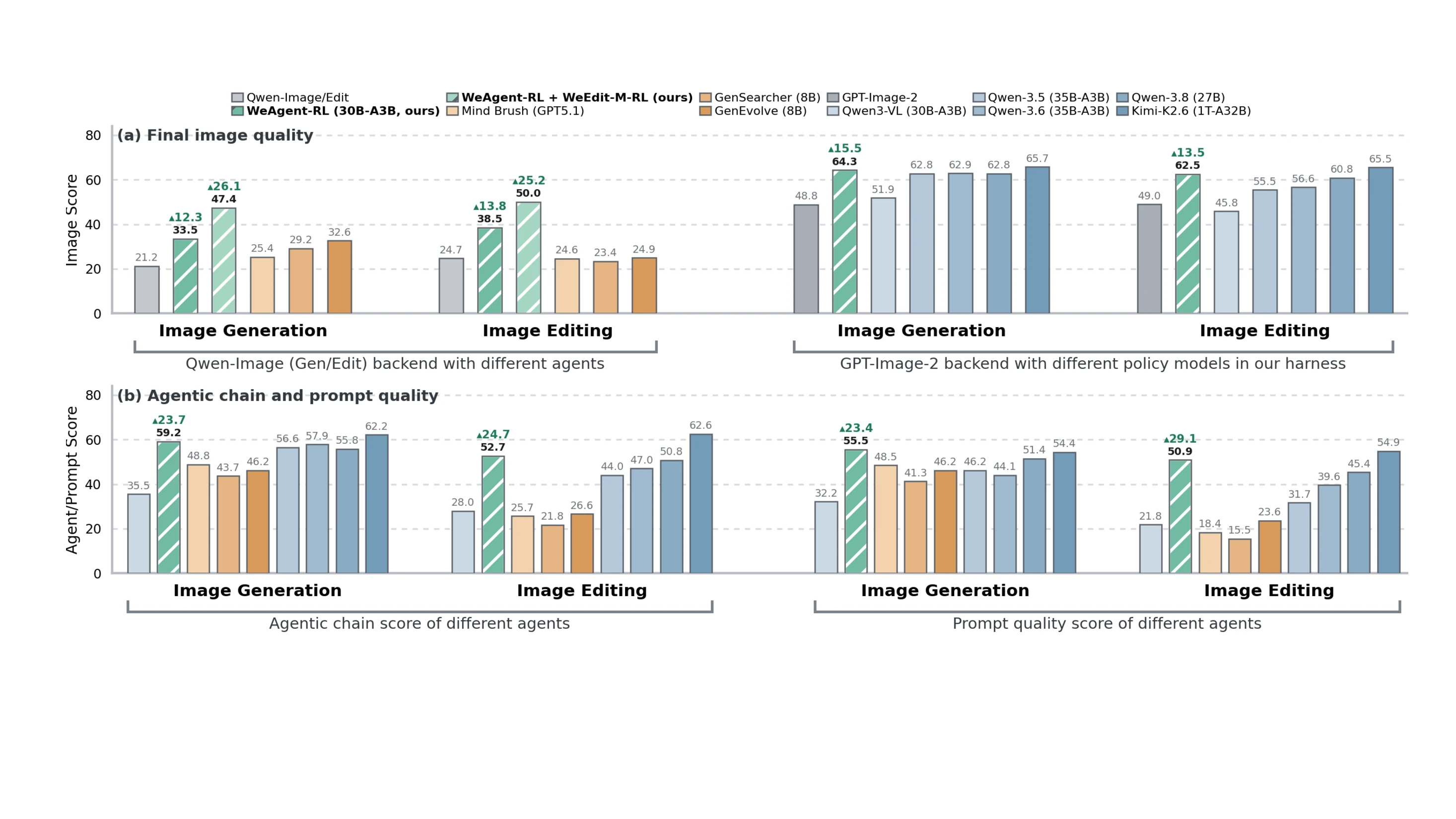
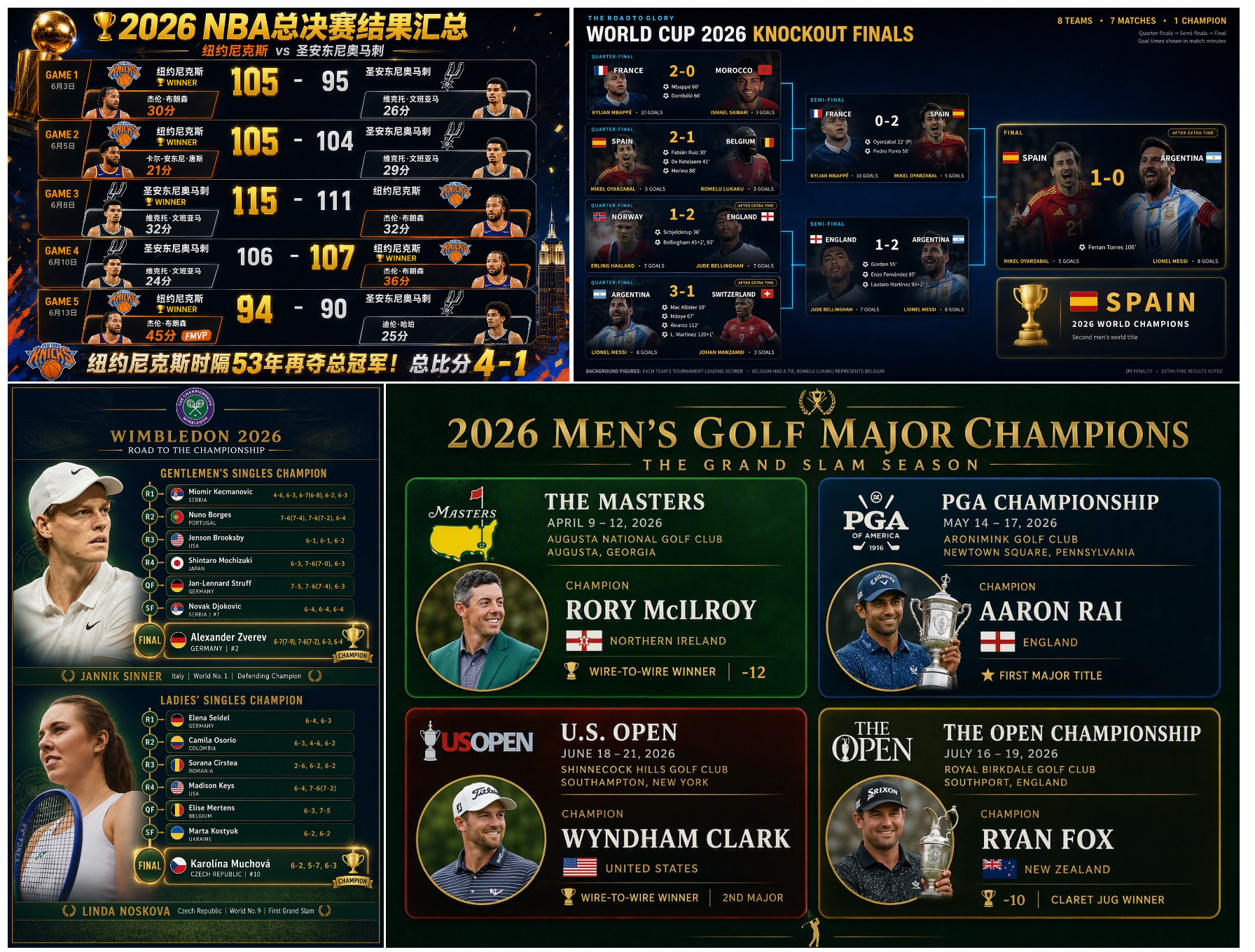
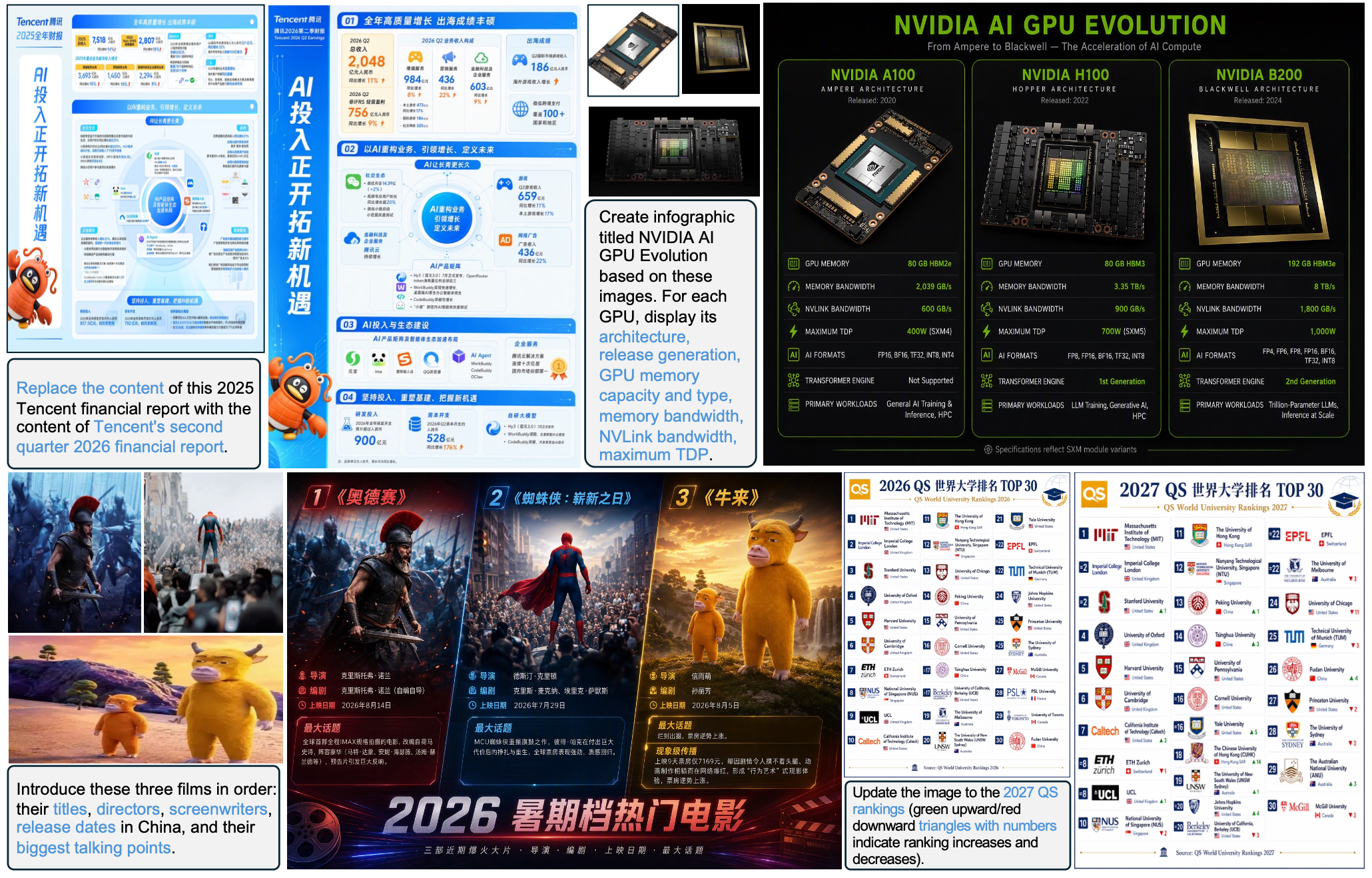
Image generation and editing models have advanced rapidly, yet remain unreliable when prompts require external world knowledge. Bounded and long-tail parametric knowledge prevents direct or reason-then-generate approaches from recovering the required facts and visual appearances. Existing agentic methods add retrieval, but remain constrained by insufficient visual verification, overloaded policy models, and weak integration of textual and visual evidence. We present WeAgent-MMGenEdit, a full-stack recipe spanning a multimodal harness, scalable data construction, a comprehensive benchmark, and post-training for both the agent policy and image backend. WeAgent-Harness manages persistent evidence and provides dedicated verification and integration tools that organize retrieved evidence into a dense carrier. Our pipeline yields 23K supervised trajectories and 14.7K RL tasks with three-layer verifiable checklists, while WeBench-MMGenEdit evaluates bilingual knowledge-intensive generation and multi-image editing. Together, these components enable a 30B-total / 3B-active policy to outperform similarly sized policy models and approach the performance of a trillion-parameter agent.
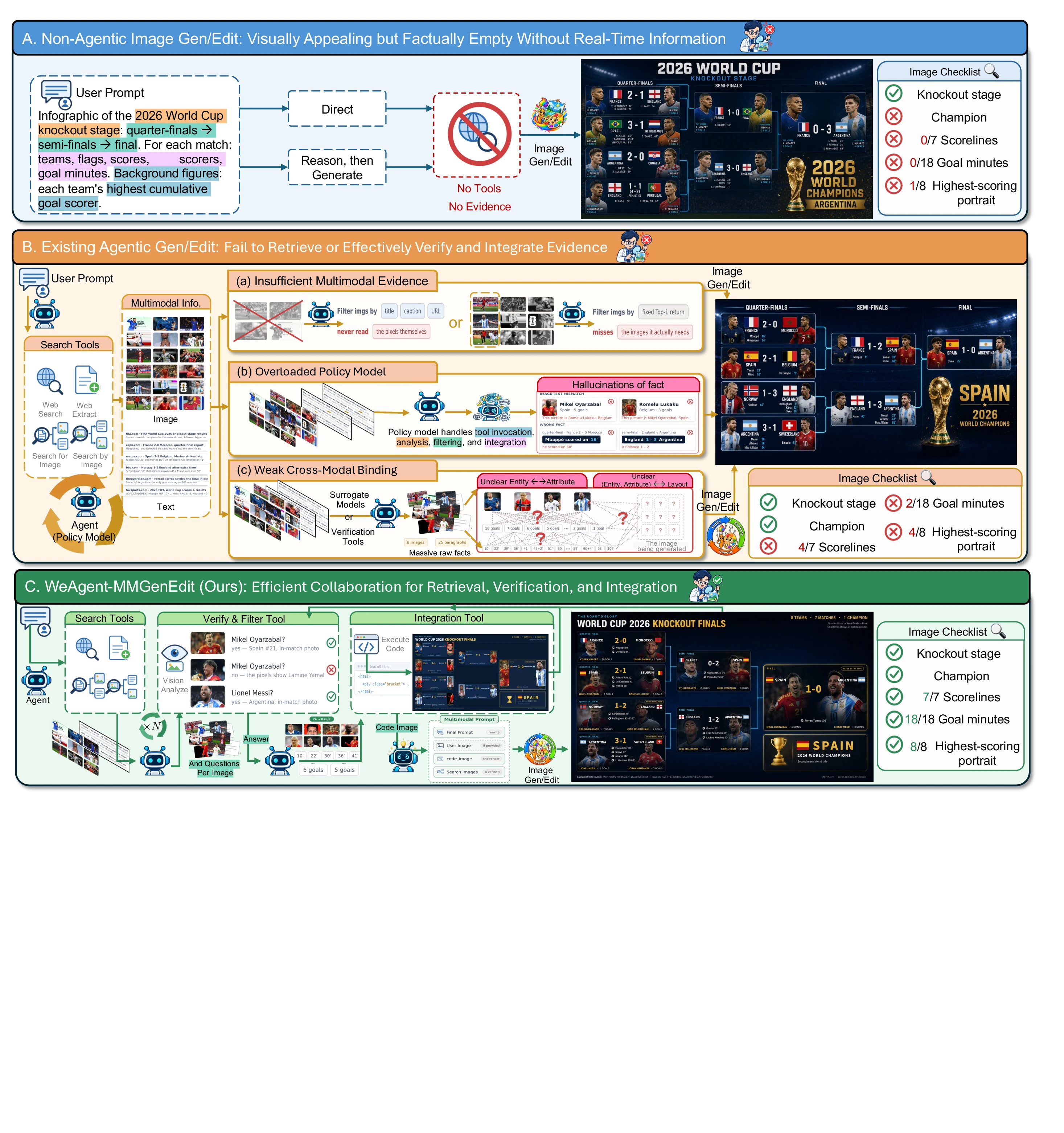
Reliable knowledge-intensive generation is a full-stack problem. We jointly build the runtime, data, benchmark, agent policy, and image backend.
Persistent evidence, explicit visual verification, and code-based integration keep long-horizon research grounded.
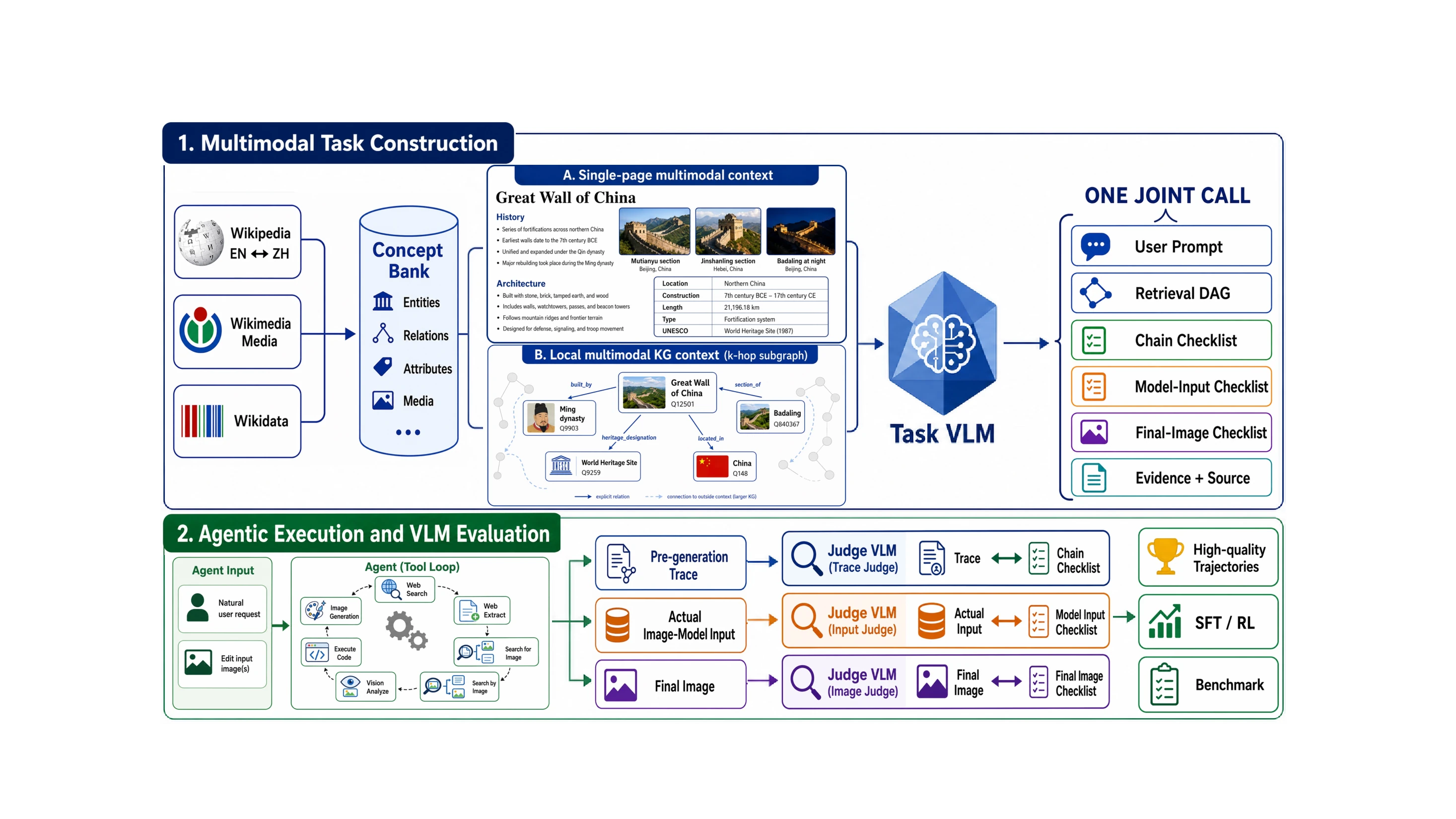
Bilingual multi-hop tasks are paired with aligned checklists for the agentic chain, model input, and final image.
Three isolated evaluation levels measure the agentic chain, generation input, and final image.
Supervised fine-tuning and checklist-grounded RL teach the policy to retrieve, verify, and compose evidence.
Multi-reference SFT and reward-driven diffusion RL improve reference conditioning and faithful rendering.
A persistent multimodal runtime for retrieval, verification, structured integration, and delivery.
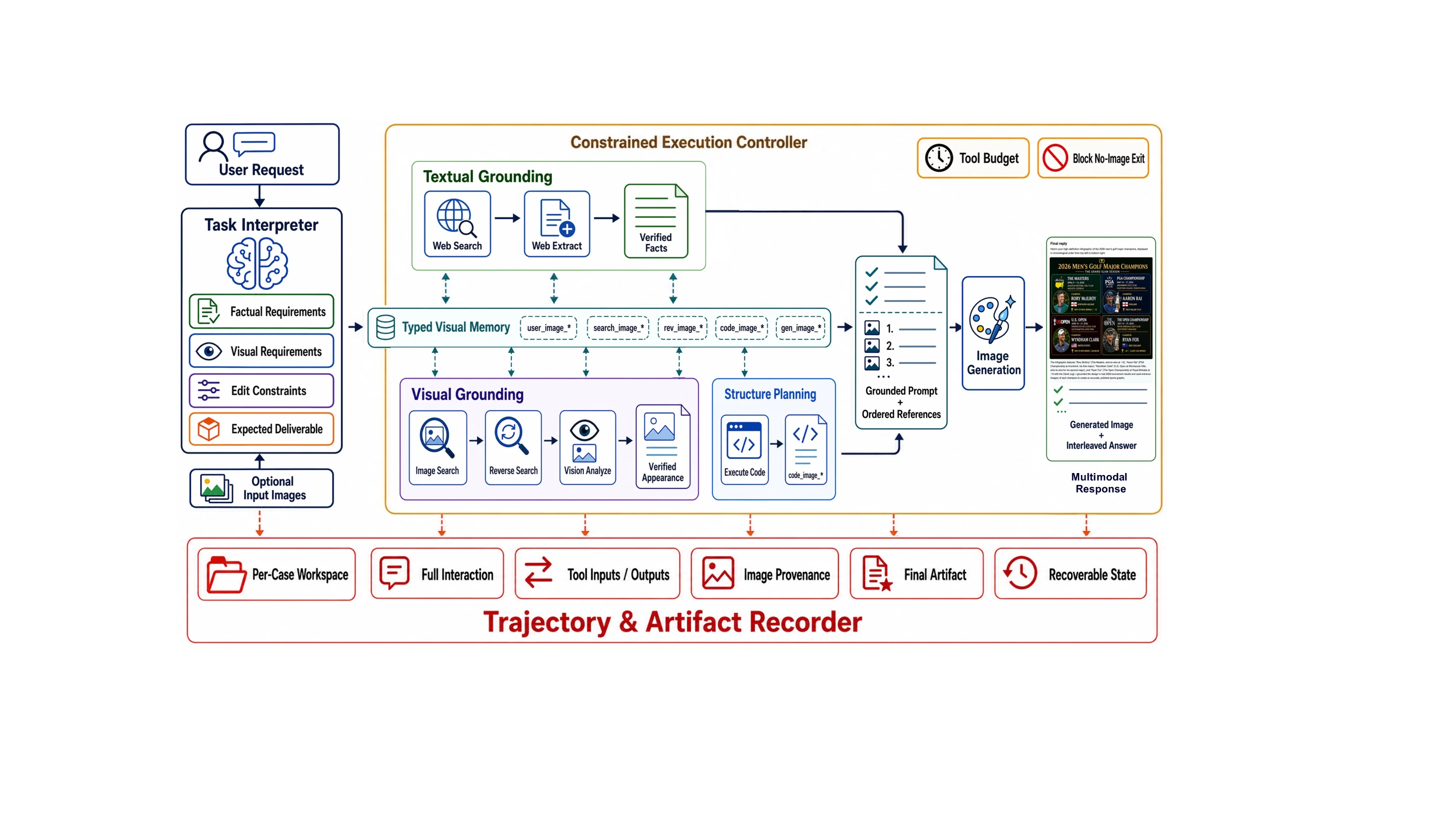
Web and image search build a broad pool of external evidence.
Focused visual analysis separates inspected references from raw candidates.
Code-rendered carriers bind entities, attributes, facts, and layout in pixels.
One interface supports generation and editing with ordered references.
Bilingual multimodal knowledge becomes verifiable multi-hop tasks, expert trajectories, and targeted post-training data.
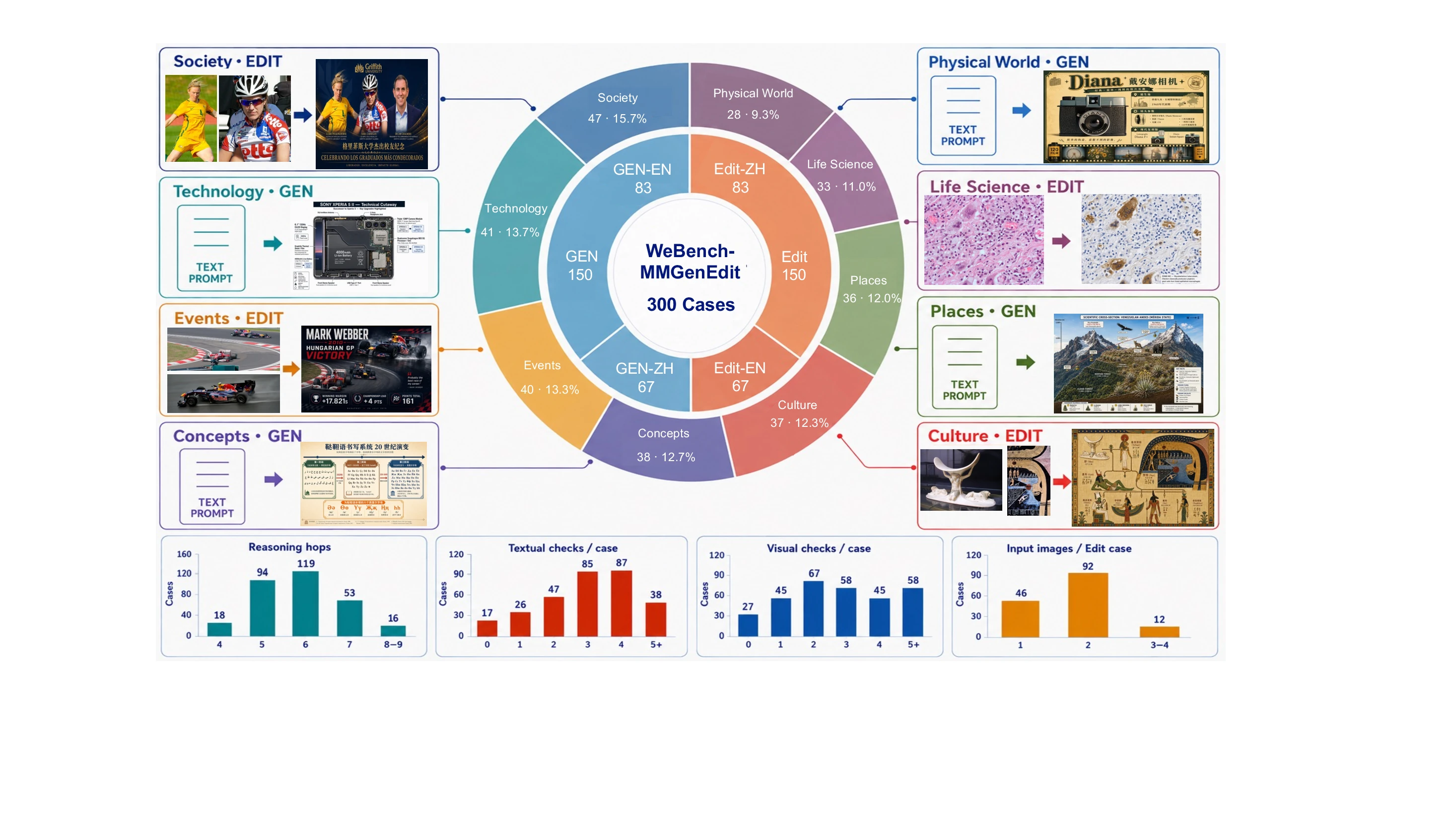
A human-audited bilingual benchmark that gives generation and editing equal weight.
The policy first learns the complete harness protocol from expert trajectories, then improves evidence acquisition and integration with checklist-grounded reinforcement learning.
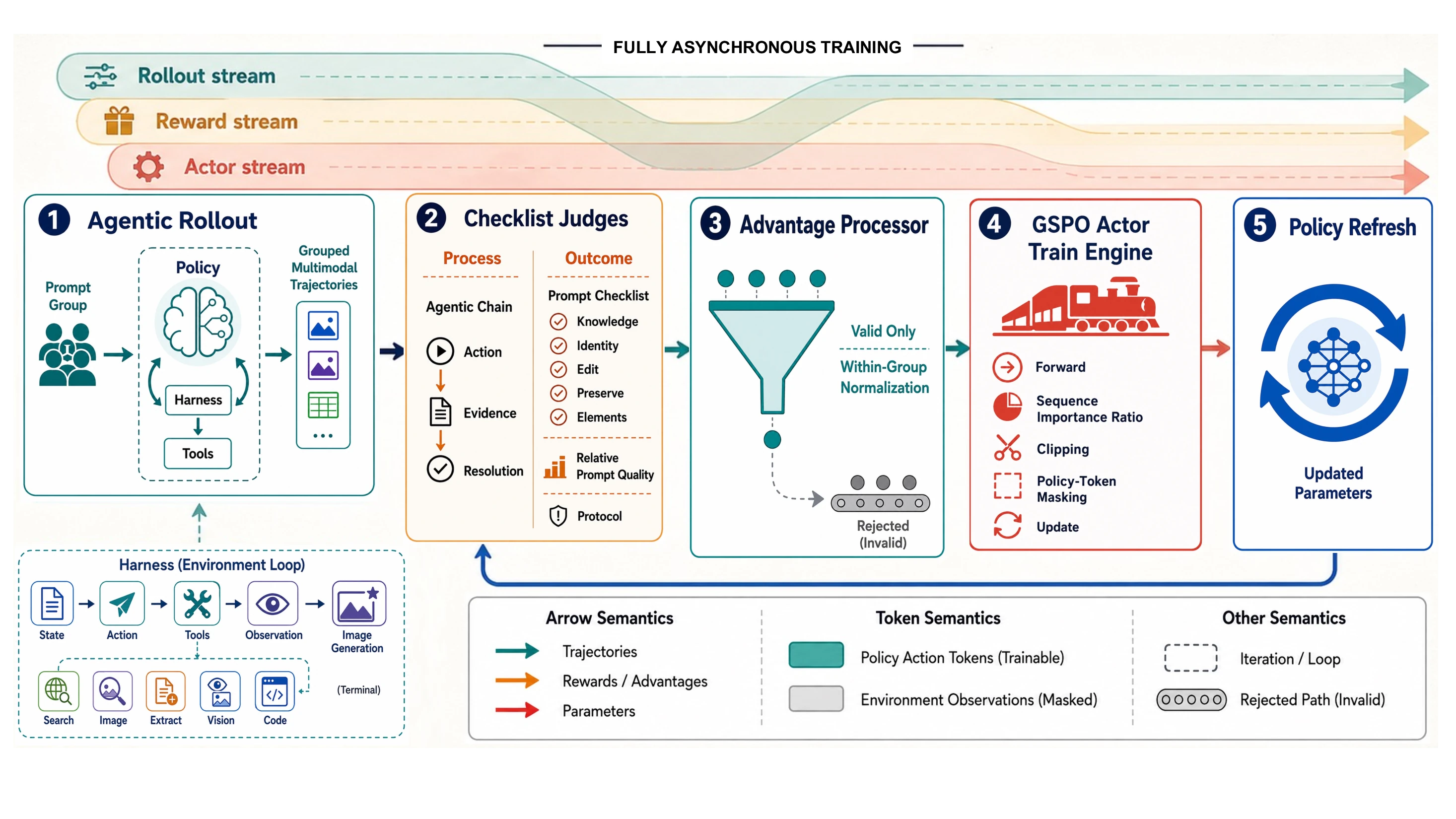
Next-token supervision over policy-generated reasoning, tool calls, and final responses teaches reliable use of WeAgent-Harness from 23K expert trajectories.
Two isolated judges score the agentic process and final multimodal input. Invalid tool trajectories are excluded before group-relative GSPO updates.
The image backend learns to consume heterogeneous ordered references and faithfully render factual content, fine-grained text, identities, and preserved regions.
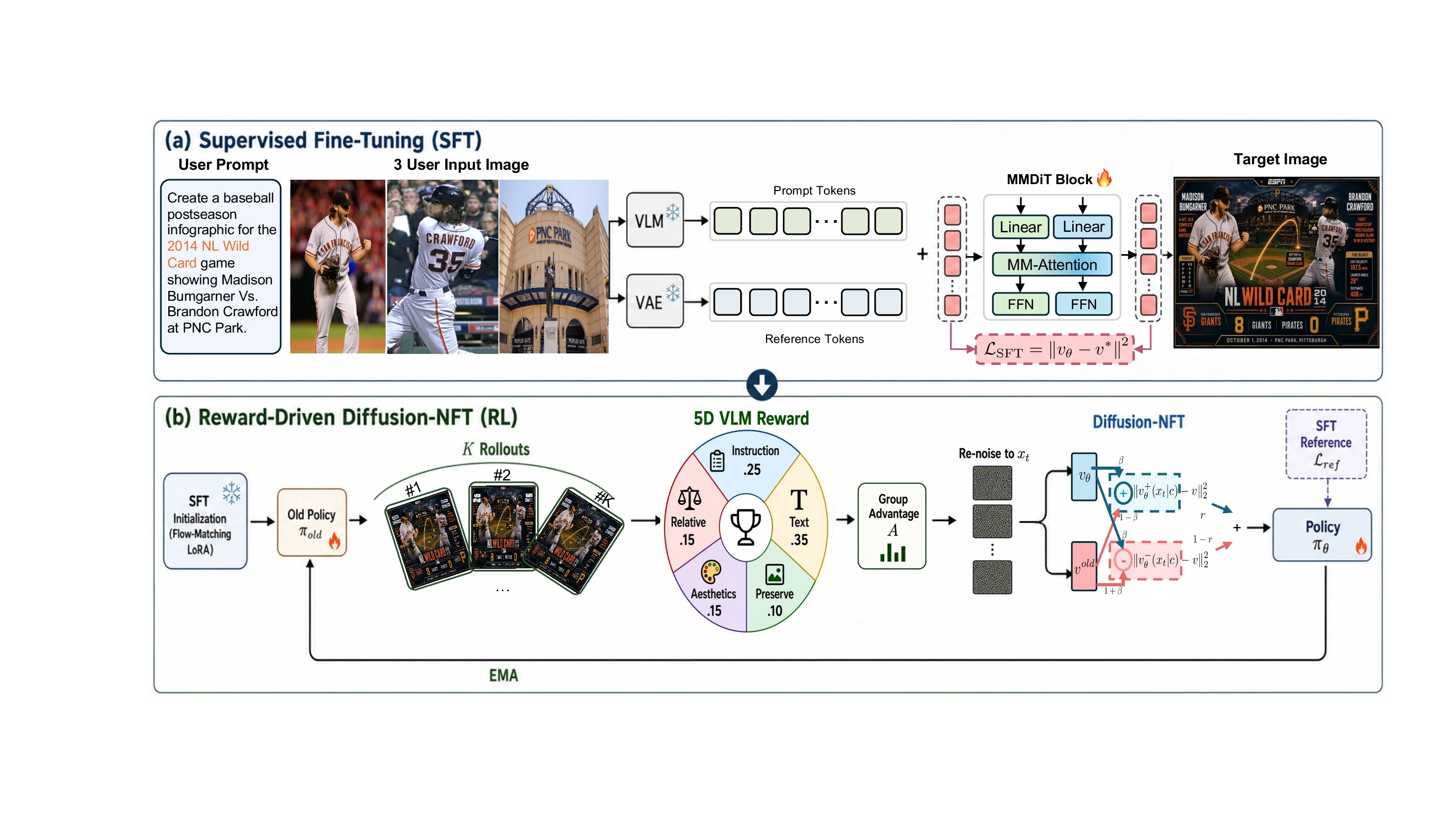
Independent resolution buckets and target-only flow-matching supervision support one to five references with different aspect ratios and semantic roles.
Diffusion-NFT optimizes instruction accuracy, text accuracy, preservation, aesthetics, and relative quality while remaining anchored to the SFT model.
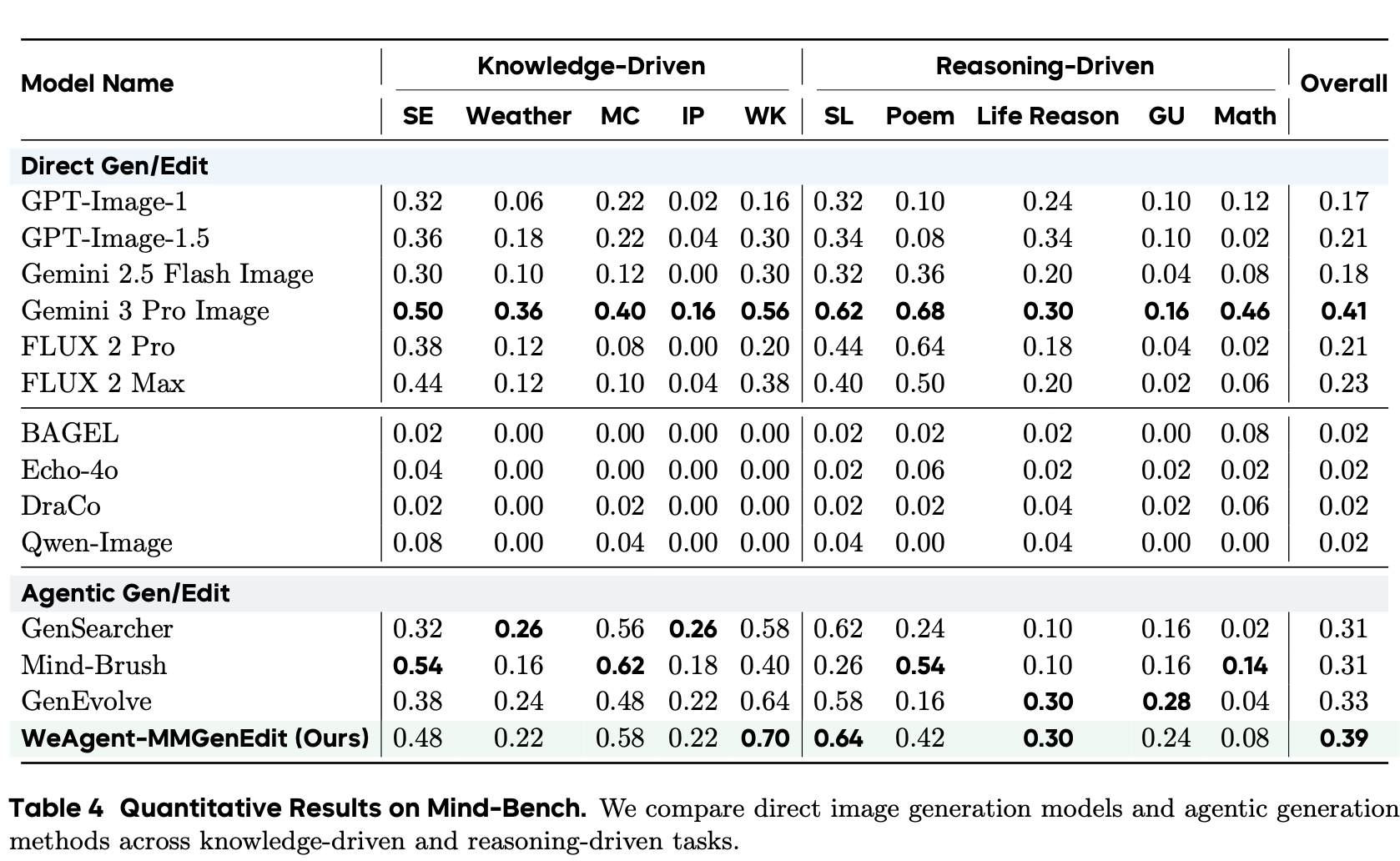
Browse the complete WeBench-MMGenEdit results, agentic chain and prompt scores, and evaluations on KnowGen and Mind-Bench.
Qwen-Image/Edit backend, from direct generation to the full system.
Knowledge-intensive editing improves with agent and image-side post-training.
The post-trained policy retrieves, verifies, and integrates evidence more reliably.
Verified visual knowledge survives into the final generation request.
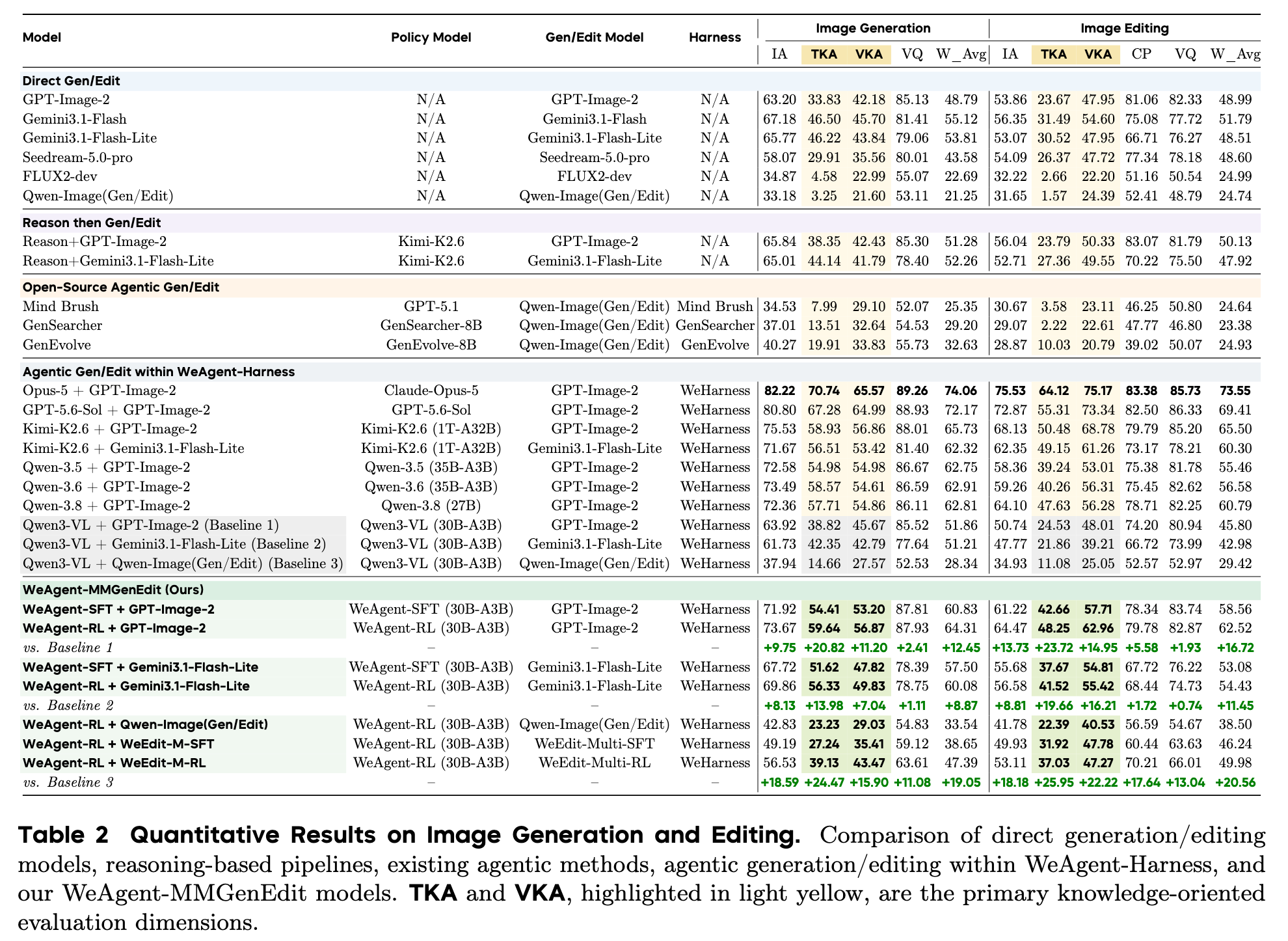
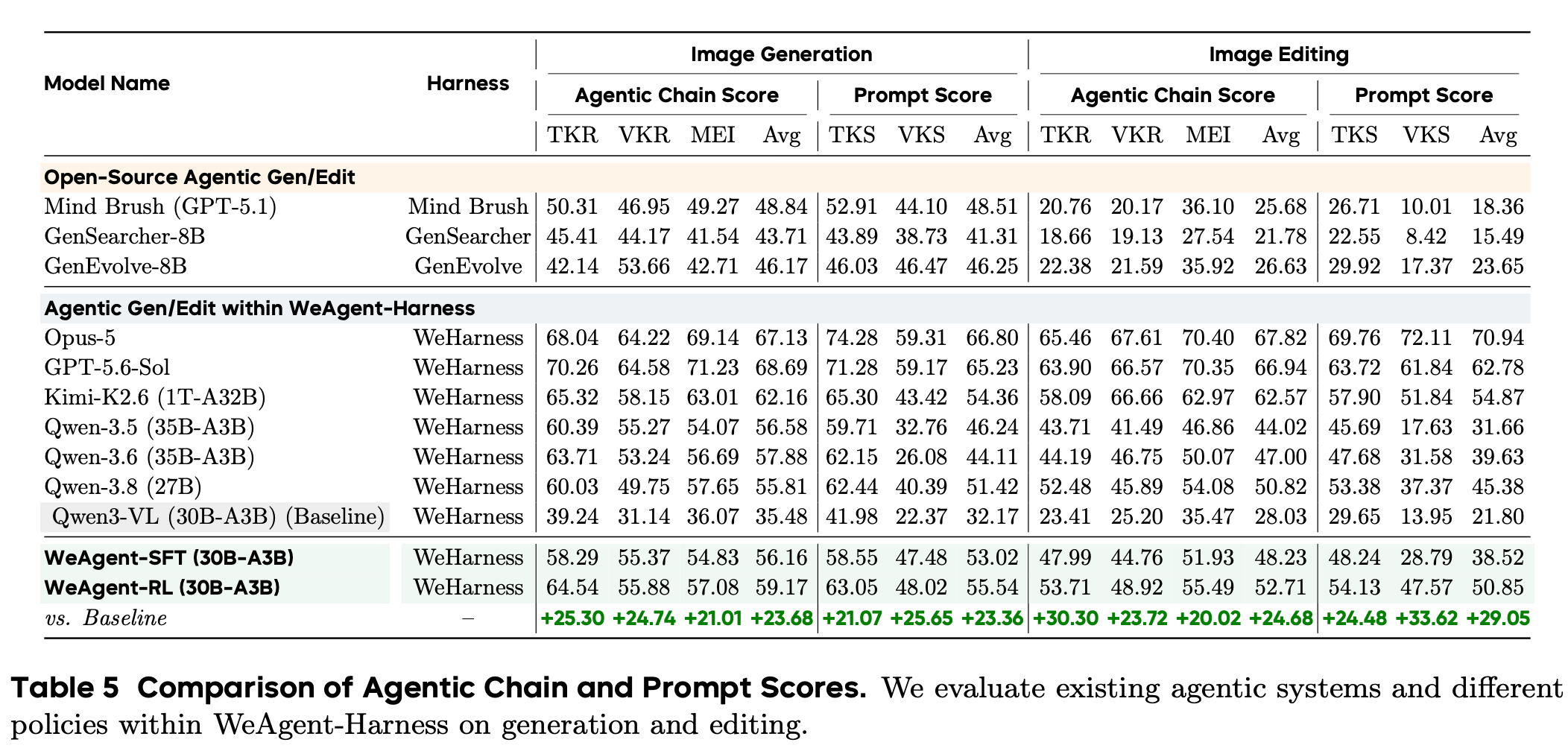
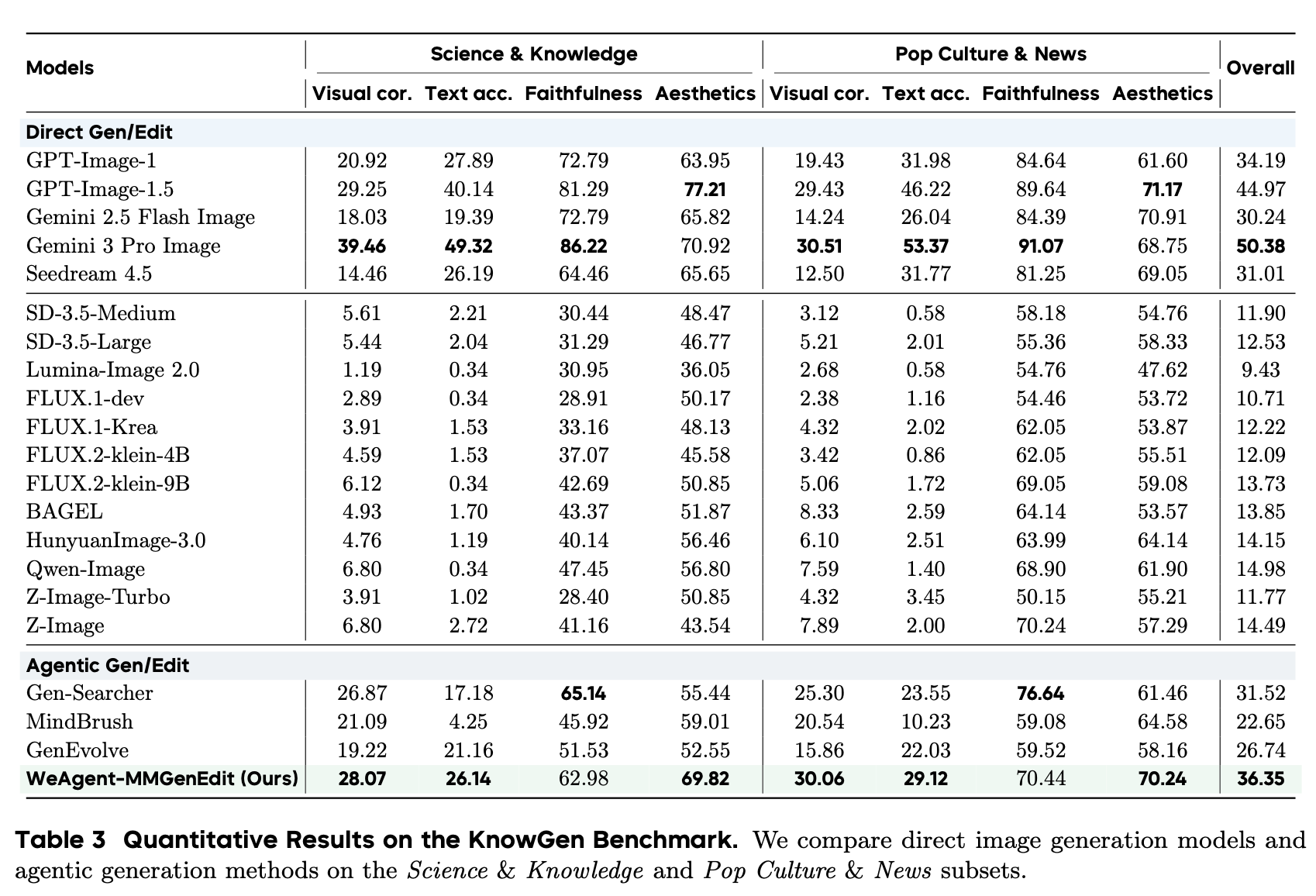
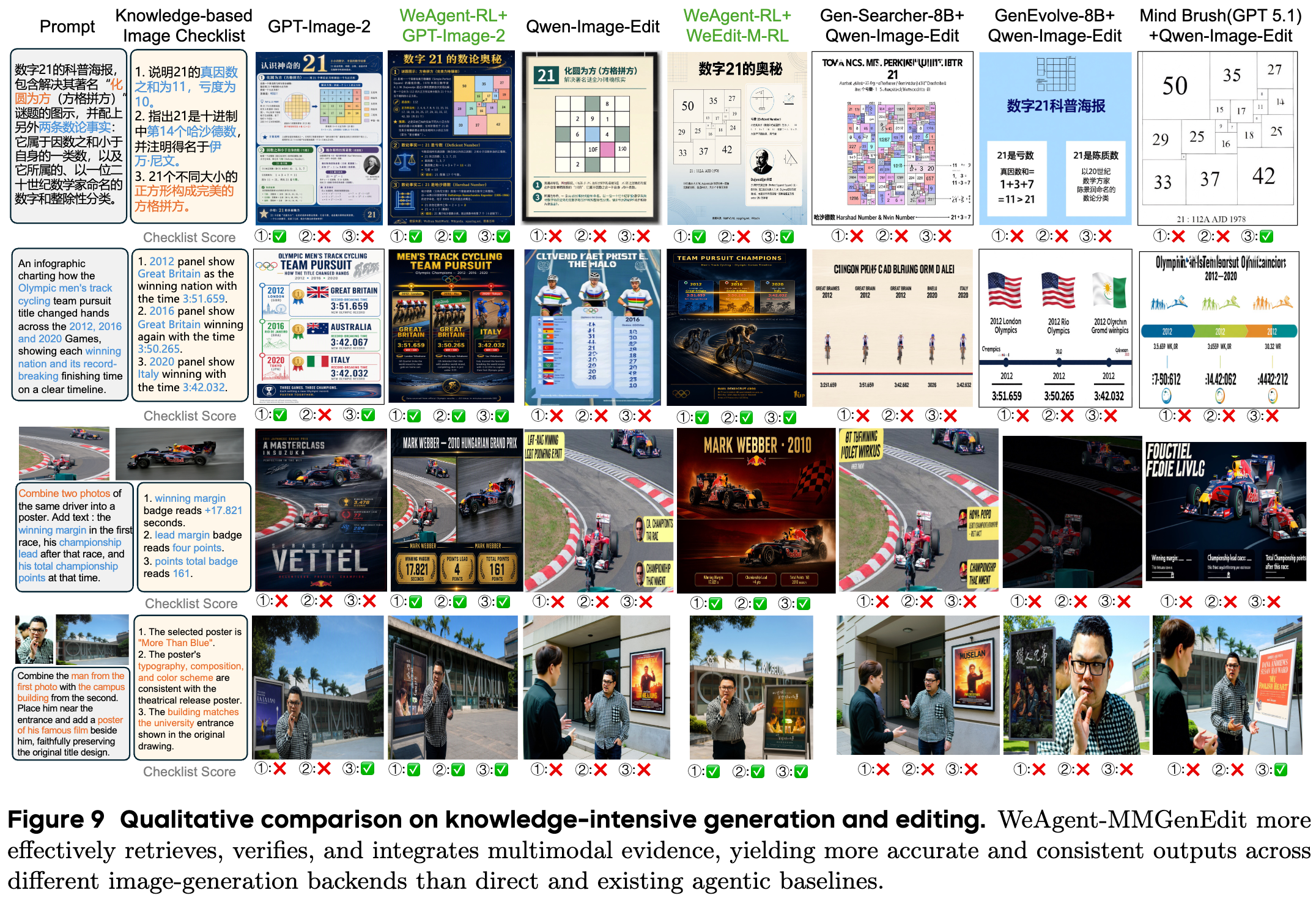
Across knowledge-rich infographics and multi-reference edits, the complete system preserves more of the facts, identities, constraints, and layout requested by the user.
@article{zhang2026weagent,
  title={WeAgent-MMGenEdit: A Full-Stack Recipe for Multimodal Agentic Image Generation and Editing},
  author={Zhang, Hui and Liu, Zongkai and Niu, Liqiang and Liu, Juntao and Li, Han and Cao, Zhen and Chen, Wenchao and Zhao, Chengduo and Meng, Fandong},
  journal={arXiv preprint arXiv:2609.05171},
  year={2026}
}